Prepare the Site
Clear the area of debris and ensure the ground is level and compacted. Use forms or boards to contain the concrete within the desired shape.


Calculate how much concrete you need for your construction project.
Enter your project measurements, then calculate a practical planning estimate.
A concrete calculator helps estimate volume before ordering bags or ready-mix. Homeowners use it for patio slabs, shed pads, walkways, fence post pads, small repairs, and driveway sections where depth mistakes quickly change the order. The result shows base concrete volume, waste allowance, total required volume, and estimated bags.
Step 1: enter the finished length, width, and depth. Step 2: the calculator multiplies those dimensions to get volume. Step 3: it adds waste for uneven subgrade, form movement, and handling loss, then converts the volume into bag estimates using the calculator yield.
Example: A homeowner is pouring a 10 ft x 12 ft patio slab at 4 inches thick. Convert 4 inches to 0.333 ft. Volume = 10 x 12 x 0.333 = about 40 cubic ft, or 1.48 cubic yd. With 5% waste, order planning is about 1.55 cubic yd before rounding to supplier or bag quantities.
Clear the area of debris and ensure the ground is level and compacted. Use forms or boards to contain the concrete within the desired shape.
Follow the manufacturer's instructions for water-to-concrete ratio. Too much water weakens the concrete; too little makes it hard to work with.
Concrete starts setting within 30-45 minutes. Have all tools ready and work efficiently to finish before it hardens.
Keep concrete moist for 7-14 days after pouring. This helps it reach full strength and prevents cracking.

Learn concrete basics for home projects, including concrete types, volume calculation, cost factors, and practical DIY planning tips.
Construction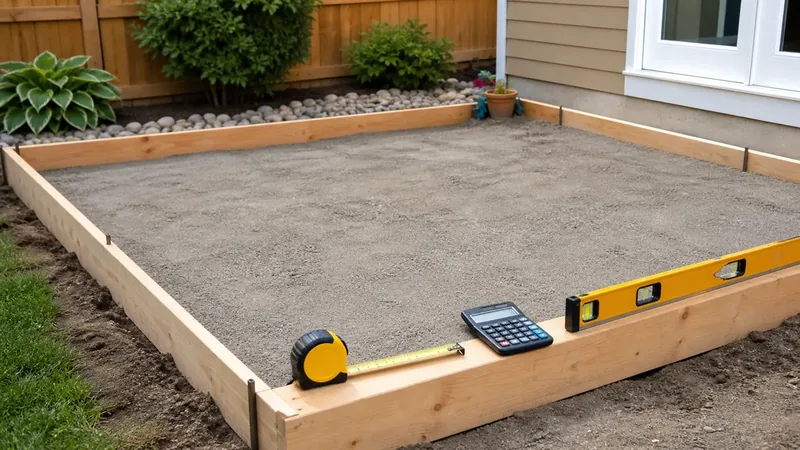
Calculate concrete volume for slabs, footings, and small homeowner projects in cubic feet, yards, or meters.
Construction