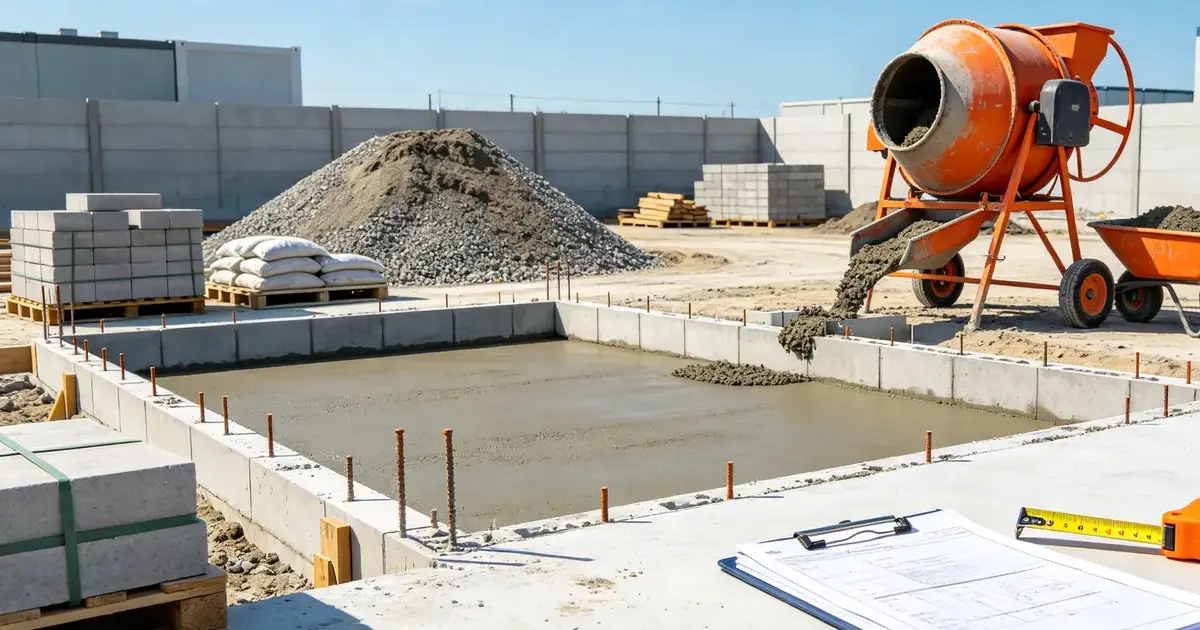
Concrete is one of the most widely used construction materials in the world, and for good reason. From driveways and patios to sidewalks and foundations, concrete forms the backbone of countless American home improvement projects. Whether you're pouring a new driveway, creating a backyard patio, or laying a foundation for a shed, understanding concrete basics is essential for a successful project. One of the biggest mistakes DIYers make is underestimating how much concrete they need, leading to mid-project shortages or costly overages. Accurate calculation using a concrete calculator prevents material waste and keeps your project on budget. In this comprehensive guide, we'll cover everything you need to know about concrete—from its composition and types to volume calculation and cost factors. By the end, you'll be equipped to tackle your next concrete project with confidence.
Introduction
Concrete is the foundation of modern construction, used in everything from residential driveways to commercial skyscrapers. For American homeowners, concrete is the go-to material for outdoor projects like driveways, patios, walkways, and garage floors, as well as structural elements like foundations and retaining walls. Despite its widespread use, many DIYers struggle with the basics of working with concrete—particularly when it comes to calculating how much material they need. Ordering too little concrete means a delayed project and potential cold joints where new concrete meets partially cured concrete. Ordering too much wastes money and creates disposal problems. The key to success lies in understanding concrete composition, accurately measuring your project area, and using a reliable concrete volume calculator to determine your exact material needs. This guide will walk you through every aspect of concrete work, from selecting the right type of concrete to calculating volume and avoiding common mistakes that can derail your project.
What Is Concrete?
Many people use the terms "concrete" and "cement" interchangeably, but they're actually quite different. Understanding the distinction is the first step to mastering concrete work:
- Cement: A fine powder made from limestone, clay, and other minerals that acts as the binding agent in concrete. Portland cement is the most common type used in residential construction.
- Water: Activates the chemical reaction (hydration) that causes cement to harden and bind the other ingredients together. The water-to-cement ratio determines concrete strength.
- Aggregates: Sand, gravel, and crushed stone that make up about 60-80% of concrete's volume. Aggregates provide structural strength and reduce the amount of cement needed.
- Concrete: The final product created by mixing cement, water, and aggregates. Concrete is much stronger than cement alone and can last for decades when properly installed.
Understanding Concrete Basics
Concrete is a composite material made from four key components that work together to create a strong, durable building material:
Concrete Volume Calculation Formula
Calculating concrete volume is essential for ordering the right amount of material. The basic formula is straightforward:
Volume Calculation
Paint Needed =
Volume = Length × Width × Depth
Always convert measurements into the same units (e.g., all in feet)
Cubic Yards Conversion
Paint Needed =
Cubic Yards = Cubic Feet ÷ 27
1 cubic yard = 27 cubic feet
Example Concrete Calculation
Let's walk through a real-world example to see how these calculations work. Suppose you're pouring a concrete slab with these dimensions:
- Concrete Slab: Length = 20 ft, Width = 10 ft, Depth = 0.5 ft (6 inches)
- Step 1: Calculate Volume = 20 × 10 × 0.5 = 100 cubic feet
- Step 2: Convert to Cubic Yards = 100 ÷ 27 ≈ 3.7 cubic yards
- Step 3: Add 10% waste allowance = 3.7 × 1.10 ≈ 4.1 cubic yards
- Step 4: Order 4.5 cubic yards (round up to nearest 0.5 yard)
Concrete Pouring Tips
Follow these professional tips for successful concrete pouring:
- Prepare the area properly: Excavate to proper depth, add gravel base, and compact thoroughly. A solid base prevents settling and cracking.
- Check weather conditions: Pour when temperatures are between 50-90°F. Avoid rain, extreme heat, or freezing conditions.
- Calculate extra material: Always order 5-10% more concrete than calculated to account for spillage and uneven surfaces.
- Use correct mixing ratio: Follow manufacturer instructions for water-to-cement ratio. Too much water weakens concrete.
- Compact concrete properly: Use a vibrator or screed board to remove air bubbles and ensure even distribution.
- Allow enough curing time: Concrete reaches full strength in 28 days. Keep it moist during the first week for optimal results.
Concrete vs Cement: What's the Difference?
The confusion between concrete and cement is common but important to clear up. Cement is an ingredient of concrete, not the same thing. Think of cement as the flour in a cake recipe, while concrete is the finished cake. When you see a driveway, sidewalk, or foundation, you're looking at concrete—not cement. Cement makes up only about 10-15% of concrete's total volume, but it's the essential binding agent that holds everything together. The rest is aggregates and water. This distinction matters when ordering materials: if you ask for cement when you actually need concrete, you'll end up with bags of fine powder rather than the mixed material you need for your project.
Common Concrete Projects
Concrete is incredibly versatile and can be used for a wide variety of home improvement projects. Each project type has different requirements for thickness, reinforcement, and finish:
- Driveways: Typically 4-6 inches thick with reinforcement mesh or rebar. A standard 2-car driveway (20×20 feet) requires about 5-7 cubic yards of concrete.
- Patios: Usually 4 inches thick for residential patios. A 12×12 foot patio needs approximately 2 cubic yards of concrete. Decorative finishes like stamping or staining are popular.
- Walkways: Generally 4 inches thick and 3-4 feet wide. A 50-foot walkway requires about 1.5-2 cubic yards of concrete.
- Garage Floors: Typically 4-6 inches thick with reinforcement. A standard 2-car garage (24×24 feet) needs 7-11 cubic yards of concrete.
- Small Foundations: Thickness varies by structure, typically 8-12 inches for shed foundations. Requires careful preparation and may need professional installation.
Types of Concrete
Not all concrete is the same. Different projects require different concrete formulations:
- Standard Concrete: The most common type for residential projects. Typically has a compressive strength of 3,000-4,000 PSI (pounds per square inch). Suitable for driveways, patios, and walkways.
- High-Strength Concrete: Formulated to withstand 6,000 PSI or more. Used for structural applications like foundations, retaining walls, and commercial construction.
- Ready-Mix Concrete: Delivered by a concrete truck already mixed and ready to pour. Most practical for projects requiring more than 1 cubic yard of concrete. Ensures consistent quality and proper mixing.
- Decorative Concrete: Specialty concrete designed for aesthetic appeal. Includes stamped concrete (mimics stone or brick), stained concrete (colored surface), and exposed aggregate (decorative stones visible on surface).
- Bagged Concrete Mix: Pre-mixed dry concrete available in 60-80 lb bags at home improvement stores. Ideal for small projects under 1 cubic yard. Just add water and mix.
How to Calculate Concrete Volume
Calculating concrete volume is the most critical step in planning any concrete project. The formula for a rectangular slab is straightforward, but you need to understand the units used in the United States:
Step 1: Calculate Volume in Cubic Feet
Wall Area =
Volume = Length × Width × Depth
All measurements should be in feet for cubic feet result
Step 2: Convert to Cubic Yards
Paint Needed =
Cubic Yards = Cubic Feet ÷ 27
1 cubic yard = 27 cubic feet (since 1 yard = 3 feet, and 3×3×3 = 27)
Understanding Concrete Units
In the United States, concrete is sold by the cubic yard for large projects and by the bag for small projects. Understanding these units is essential for accurate ordering:
- Cubic Feet: The basic unit for calculating volume. One cubic foot equals 12×12×12 inches. Useful for small project calculations.
- Cubic Yards: The standard unit for ordering ready-mix concrete. One cubic yard equals 27 cubic feet or 3×3×3 feet. Most concrete trucks carry 8-10 cubic yards.
- Conversion Formula: 1 cubic yard = 27 cubic feet. To convert cubic feet to cubic yards, divide by 27. To convert cubic yards to cubic feet, multiply by 27.
- Bagged Concrete: An 80-pound bag of concrete mix yields about 0.6 cubic feet when mixed with water. A 60-pound bag yields about 0.45 cubic feet.
How Much Concrete Do I Need?
Follow these five steps to calculate exactly how much concrete you need for your project. Using our concrete calculator can handle this math automatically, but understanding the process helps you verify your results:
- Step 1: Measure the length of your project area in feet
- Step 2: Measure the width of your project area in feet
- Step 3: Measure the depth (thickness) in feet (4 inches = 0.33 feet, 6 inches = 0.5 feet)
- Step 4: Calculate volume: Length × Width × Depth = Cubic Feet, then divide by 27 for Cubic Yards
- Step 5: Add 5-10% extra allowance for spillage, uneven subgrade, and settling
Example Calculation
Let's walk through a real-world example. Suppose you're pouring a 10×12 foot patio that's 4 inches thick. Here's how to calculate the concrete needed using our concrete volume calculator approach:
Step 1: Convert Depth to Feet
Wall Area =
4 inches ÷ 12 = 0.33 feet
Always convert inches to feet for consistent units
Step 2: Calculate Cubic Feet
Paint Needed =
10 × 12 × 0.33 = 39.6 cubic feet
Length × Width × Depth in feet
Step 3: Convert to Cubic Yards
Paint Needed =
39.6 ÷ 27 = 1.47 cubic yards
Divide cubic feet by 27 to get cubic yards
Step 4: Add 10% Extra
Paint Needed =
1.47 × 1.10 = 1.62 cubic yards
Order 1.75 cubic yards to round up for safety
Concrete Cost Factors
The cost of a concrete project depends on several factors. Understanding these helps you budget accurately:
- Material Price: Ready-mix concrete costs $100-$150 per cubic yard. Bagged concrete costs $4-$6 per 80-pound bag, which works out to about $200-$250 per cubic yard.
- Delivery Fee: Ready-mix companies charge $50-$100 for delivery, plus additional fees for small loads under 3 cubic yards. Short-load fees can add $100-$200 to small orders.
- Labor Cost: Professional concrete installation costs $3-$10 per square foot, depending on complexity. Decorative finishes like stamping add $5-$15 per square foot.
- Project Size: Larger projects cost less per square foot due to economies of scale. Small projects under 1 cubic yard are often more cost-effective using bagged concrete.
- Site Preparation: Excavation, grading, and formwork add $1-$3 per square foot. Existing concrete removal costs $2-$6 per square foot.
Common Concrete Mistakes
Avoid these common mistakes that can ruin your concrete project:
- Incorrect Measurements: Failing to measure accurately leads to ordering too much or too little concrete. Always measure twice and use a concrete calculator to verify.
- Forgetting Depth: Many DIYers calculate square footage but forget to account for depth. A 4-inch slab requires half the concrete of an 8-inch slab.
- Not Ordering Extra Material: Always order 5-10% more concrete than calculated. Running out mid-pour creates weak cold joints that compromise structural integrity.
- Poor Preparation: Inadequate site preparation, including improper grading and lack of reinforcement, leads to cracking and settling within the first year.
- Wrong Water Ratio: Adding too much water makes concrete easier to work with but significantly reduces strength. Follow manufacturer instructions for water-to-cement ratio.
- Rushing the Cure: Concrete needs time to cure properly. Walking on it too soon or removing forms too early causes cracks and surface damage.
DIY Concrete Tips
If you're planning to pour concrete yourself, these professional tips will help ensure success:
- Prepare the Base: Excavate to proper depth, add 4-6 inches of crushed gravel, and compact thoroughly. A solid base prevents settling and cracking.
- Check Weather Conditions: Pour concrete when temperatures are between 50-90°F. Avoid pouring in rain, extreme heat, or freezing conditions. Hot weather causes rapid drying; cold weather prevents proper curing.
- Use Proper Tools: Essential tools include a wheelbarrow, shovel, hoe, screed board, bull float, edger, and finishing trowel. Rent power tools for larger projects.
- Allow Curing Time: Concrete reaches 50% strength in 24-48 hours, 70% in 7 days, and full strength in 28 days. Keep it moist during the first week for optimal strength.
- Use Reinforcement: Wire mesh or rebar prevents cracking and adds structural strength. Place reinforcement in the middle of the slab thickness for maximum effectiveness.
- Work Quickly: Concrete begins setting within 30-60 minutes. Have all tools and helpers ready before mixing. Work in small sections if pouring a large area.